



Custom Wood Wine Racking: The Craftsmanship Behind Every Component
Custom wood wine racking is an important part of a wine cellar's design. It shapes the room's appearance while providing the structure needed to store and display a collection. Quality racking depends on thoughtful wood selection, accurate computer-controlled cutting, careful sanding, and secure, consistent construction.
At Wine Appreciation, our approach to wood wine racking reflects decades of experience in wine storage. Every component matters—from the character of the wood to the smoothness of each surface, the accuracy of each cut, and the way the finished sections fit together.
Choosing the Right Wood for Wine Racking
Wood helps establish the character of a wine cellar. Grain, natural color, and texture all influence the finished appearance. Available choices include all-heart redwood, walnut, alder, and white oak, each offering a distinct look that can be coordinated with cabinetry, flooring, stone, lighting, and the architectural style of the room.

Jim Mackey, whose experience with Wine Appreciation spans more than 40 years, brings an extensive engineering background and expertise in wine cellar design, cooling systems, and wine racking. His knowledge combines the technical considerations of proper wine storage with an understanding of the materials and craftsmanship that contribute to a well-designed cellar.
All-heart redwood is a particularly appealing choice for wine-cellar racking. Jim has long appreciated the way its natural reddish color can deepen and become richer as the wood ages. That gradual development gives redwood a warmth and character that can become even more distinctive over time. It is one of the qualities that makes natural wood such an enduring choice for wine cellar design.
Walnut offers deeper brown tones and distinctive grain. Alder has a more understated grain and a versatile appearance, while white oak brings a pronounced grain character that works well in both traditional and contemporary cellar designs.
Because wood is a natural material, individual boards will vary in grain and appearance. Those variations are part of the character of real wood. The selection should consider both the desired look and how the racking will complement the completed cellar.
Wood Finishes and Color Choices
Finish and color choices are an important part of the overall design. Available selections include unfinished, charcoal, bourbon, walnut, and pure. These five choices are available with all four wood species: all-heart redwood, walnut, alder, and white oak.

Wood species and color should be considered together. Natural grain and color vary, so the same color selection may look different from one species to another. The final choice should complement the cabinetry, flooring, stonework, lighting, and other design elements in the cellar.
Sanding: The Foundation of the Process
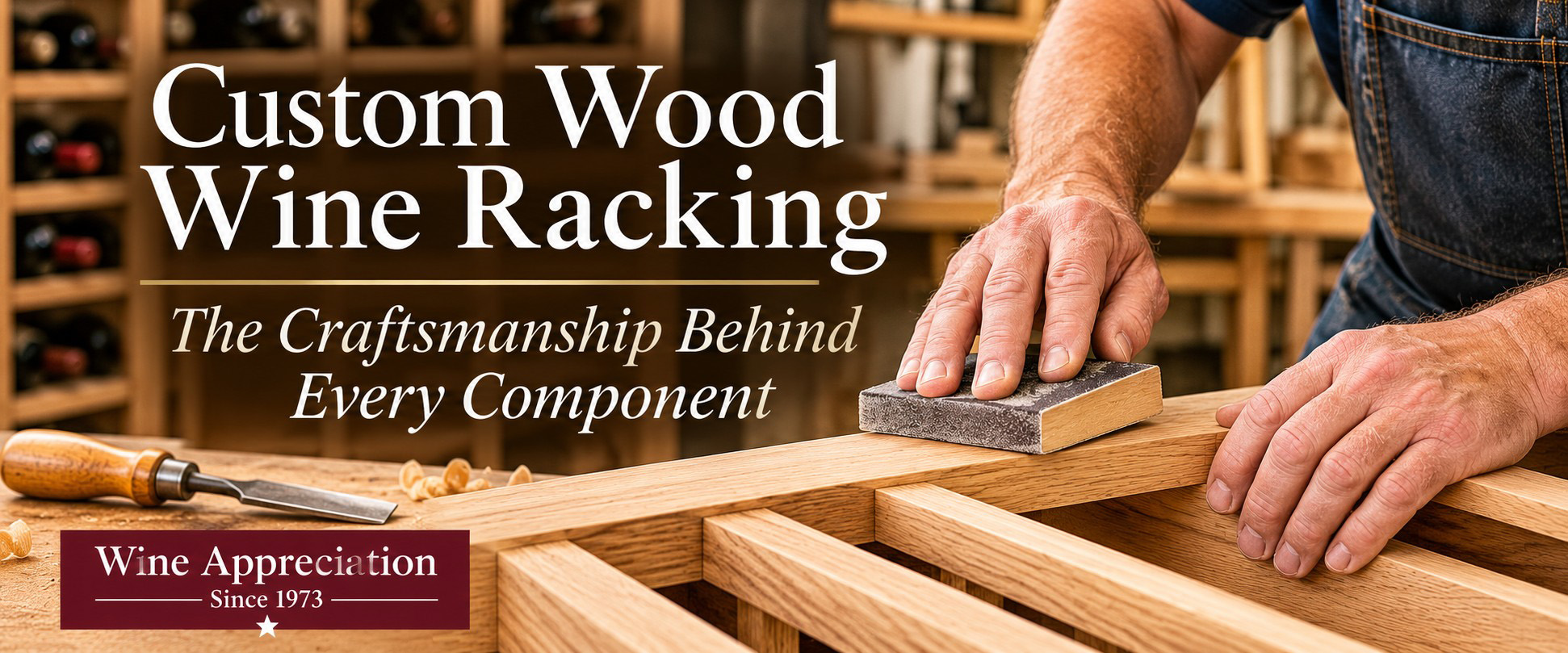
The first major step in processing the wood is sanding. Every piece passes through a machine sander and is handled individually for close inspection and hand-finishing. This allows each piece to be checked for defects and helps create a smooth surface.

The individual inspection and hand work are important for more than appearance. Rough areas, splinters, or sharp imperfections can catch or damage wine labels as bottles are placed in or removed from the racking. Careful sanding helps produce a smooth surface and reduces that risk.
After the CNC cutting stage, every part receives additional hand-finishing. The components are flat-sanded, and all sharp edges are broken by hand. This piece-by-piece work refines the surfaces and edges after machine cutting.
Precision CNC Cutting and Accurate Measurements
All of the individual parts are cut on CNC equipment. Its primary advantage is accuracy and consistency, particularly when a design requires multiple components to match. Precise, repeatable cutting helps the parts fit together properly and supports a uniform result across the completed racking.

The CNC is especially valuable for rounded and curved components, which are more difficult to produce consistently by hand. Examples include quarter-round shelving units, arches, and arched-front tabletops. CNC cutting also supports the repeatable production of solid casework and cabinet-style wine racking.
The equipment can produce consistent profiles from one component to the next while maintaining the dimensions required by the design. Whether the project calls for straight components or more distinctive curved features, accurate cutting provides a reliable foundation for the work that follows.
Every design has its own measurements and construction requirements. Rung lengths, frame dimensions, bottle openings, and spacing must work together so that components align and the completed sections fit the intended layout.
Precision-cutting individual wooden bottle supports on the chop saw to build the ladder frames of our custom wine racks.
Hand Sanding and Edge Refinement
After CNC cutting, every part is flat-sanded by hand, and all sharp edges are broken by hand. This additional step refines the surfaces and edges of each component and gives each piece individual attention after the machine-cutting process.

Hand-finishing allows each part to be checked and refined individually. Breaking the sharp edges helps create a smoother, more finished feel and reduces rough areas that could catch a wine label or detract from the appearance.
This piece-by-piece attention is important across a complete installation, where many components come together. Consistent surfaces and softened edges contribute to the quality of the finished racking.
Custom Fixture and Individual-Bottle Frame Construction
A variety of custom fixtures are used in production to help achieve the requested design. Their main advantage is speed, but they also improve accuracy by helping position components consistently. Different fixtures are used for different configurations and construction requirements.

For individual-bottle storage, ladder-style fixtures help position the bottle supports and vertical members while each frame is assembled. These templates help maintain the required spacing and repeatability. A range of fixtures can accommodate the design and configuration specified for each project.
Each individual bottle support is glued to the vertical supports at both the front and back of the connection. Two types of fasteners are also used. On one side, a 1/4-inch crown staple is blind-nailed so that it is not visible. The staple provides additional holding strength and shear resistance across the ladder. On the visible side, an 18-gauge pin nail is used.
The combination of glue and two fastener types creates a secure connection at each bottle support. The concealed crown staple adds holding strength, while the visible-side pin nail provides a discreet mechanical fastening. These details are part of how the individual-bottle ladder frames are constructed.
Designing Wine Racking Around Your Collection
The racking must work for the collection it will hold. Bottle shapes, storage capacity, display preferences, and the dimensions of the room all influence the layout. A design that looks beautiful but does not accommodate the owner's bottles or storage needs is not a successful solution.
Individual-bottle storage, larger-format bottle accommodations, display sections, and presentation areas can all be considered when planning a custom layout. Available wall space, ceiling height, doorways, architectural features, and access to the collection also help determine the configuration and dimensions of the racking.
Good design brings together the practical requirements of the collection and the visual character of the room. Wood species, finish, bottle presentation, and the overall pattern of the racking should work as a coordinated whole.
Wood Wine Racking from Wine Appreciation

From wood selection and machine sanding to CNC cutting, individual hand-sanding, and carefully constructed bottle-storage frames, quality wood wine racking depends on a series of coordinated steps. Accuracy, smooth surfaces, and secure connections all contribute to the completed product.
At Wine Appreciation, we bring decades of wine storage experience to helping customers select racking that suits their collections, their spaces, and their design preferences. The right wood, finish, and configuration can make the racking an integral part of the cellar—both functional and visually at home in the room.
Exceptional craftsmanship. Timeless quality.