



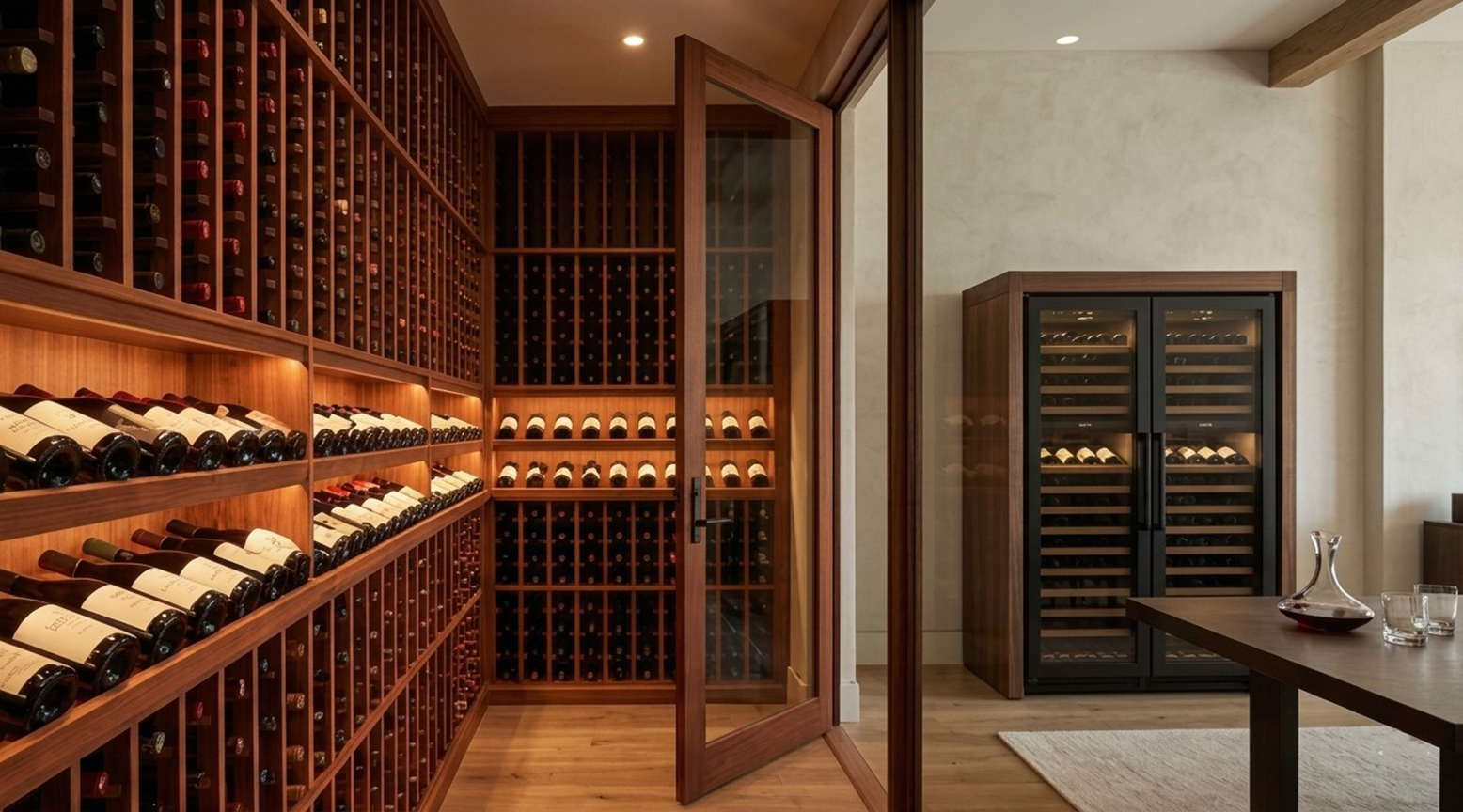
How Much Wine Storage Do You Need? Planning the Capacity for Your Collection
Whether you're building your first serious wine collection or already have hundreds of bottles, one of the most important decisions is often overlooked:
How much storage space will you actually need?
Choosing the right capacity is about more than counting the bottles you own today. A well-planned wine storage solution should accommodate your current collection, allow room for future growth, and provide enough space to store different bottle shapes and sizes properly.
For some collectors, that may mean a professional wine cabinet. For others, a custom wine cellar provides the capacity and flexibility they need. The right choice depends on your collection, your home, and how you expect your wine collection to evolve.
Start With Your Collection Today
The first step is simple: determine approximately how many bottles you currently own.
But don't stop there.
A collection of 150 bottles today could become 300 bottles surprisingly quickly if you regularly purchase wine by the case, collect specific regions or producers, or buy wines intended for long-term aging.
Before choosing a storage solution, consider:
How many bottles you own today
How many bottles you typically purchase each year
How many bottles you drink each year
Whether you buy by the case
Whether you collect wines intended to age for many years
Whether your collection is growing or remaining relatively stable
The difference between bottles purchased and bottles consumed is especially important.
If you purchase 120 bottles each year but drink only 60, your collection is growing by approximately 60 bottles annually.
That growth needs to be accounted for when planning storage.
Wine collecting can also grow unexpectedly through travel and winery-direct purchasing. If you visit wine country, it can be difficult to resist bringing home bottles as a memento of your travels. You may also join winery wine clubs, which can provide access to special releases, verticals, and wines that are difficult to find elsewhere.
These club shipments are often quarterly or annual commitments, meaning bottles can continue arriving even when you are not actively shopping for more wine.
All of this can make a collection grow faster than expected—and is another reason to plan storage capacity for the collection you are building, not simply the number of bottles you own today.
Plan for the Collection You Will Have—Not Just the Collection You Have Today
One of the most common wine storage mistakes is choosing a solution that is already nearly full when it is installed.
A completely full cabinet or wine cellar may look efficient, but it leaves little room for new purchases.
Instead, consider how large your collection could reasonably become over the next five to ten years.
For example, a collector with 250 bottles today might want to plan for 350 to 400 bottles rather than selecting a storage solution designed for exactly 250.
The right amount of extra capacity depends on your buying habits, available space, and long-term goals. The important point is to avoid designing your storage solution around a number that represents only today's collection.
How Much Can a Wine Cabinet Hold?
Professional wine cabinets are available in a wide range of capacities, making them suitable for collections ranging from relatively modest to very substantial.
However, the advertised bottle capacity of a cabinet should not be treated as an exact number for every collection.
Bottle shape matters.
A cabinet designed around standard Bordeaux bottles may hold fewer bottles when filled with larger Burgundy bottles, Champagne bottles, magnums, or other unusually shaped bottles.
Your actual capacity can also be affected by:
Bottle size and shape
Shelf configuration
Number of shelves
Bottle presentation and display requirements
Use of larger-format bottles
How much room you want between bottles
Whether some bottles need to remain easily accessible
For this reason, it is better to think of a cabinet's stated capacity as a guideline rather than a guarantee that every collection will fit the same number of bottles.
When Does a Wine Cabinet Make Sense?
A professional wine cabinet can be an excellent solution when you want serious long-term wine storage without building a dedicated wine room.
Cabinets can be particularly attractive for collectors who:
Have limited space
Live in an existing home
Do not want to undertake construction
Want a finished storage solution
Need flexibility to relocate their storage in the future
Have a collection that fits within cabinet capacity
Want to expand their collection gradually
A professional wine cabinet also allows you to add capacity over time. Some collectors prefer multiple cabinets rather than committing immediately to a large custom wine cellar.
For collectors considering a professional cabinet, our guide to choosing the right Transtherm wine cabinet can help explain the factors to consider when comparing models and configurations.
How Much Space Do You Need for a Wine Cellar?
A custom wine cellar requires a different approach to capacity planning.
With a cabinet, the manufacturer establishes the physical dimensions and approximate bottle capacity.
With a custom wine cellar, you are designing the entire environment around the collection.
The amount of wine a cellar can hold depends on:
Room dimensions
Ceiling height
Racking configuration
Bottle sizes
Door and entry locations
Walkway requirements
Display areas
Tasting or entertaining space
Mechanical and cooling requirements
Estimating Wine Storage Capacity by Wall Space
For a quick starting estimate, you can think about wine storage in terms of usable wall space.
As a general rule of thumb, one linear foot of wine racking can accommodate approximately three bottles. Using that estimate for both the width and height of a racking area, a 1-foot-wide by 1-foot-tall section of wall could hold approximately nine bottles.
3 bottles wide × 3 bottles high = 9 bottles
This simple calculation can help you visualize how quickly storage capacity adds up as racking extends across a wall.
For example:
Racking Size | Approximate Bottle Capacity |
|---|---|
1' × 1' | 9 bottles |
2' × 2' | 36 bottles |
3' × 4' | 108 bottles |
4' × 6' | 216 bottles |
5' × 8' | 360 bottles |
These are planning estimates rather than exact capacities. Actual bottle capacity will vary depending on the racking system, bottle shapes and sizes, spacing, display requirements, and the amount of wall space that can actually be dedicated to bottle storage.
A small wine room can therefore hold a surprisingly large collection when designed primarily for efficient bottle storage. A larger room may hold fewer bottles per square foot if substantial space is dedicated to seating, displays, counters, or entertaining.
This is why square footage alone does not determine wine cellar capacity.
Don't Design Every Inch for Bottle Storage
When planning a refrigerated wine room, it is good practice to size the space as efficiently as practical for the collection it is intended to hold.
A wine cellar maintained at approximately 55°F is under temperature control 24 hours a day, 365 days a year. The larger the refrigerated volume, the more cooling capacity may be required and the more energy it can take to maintain the desired environment.
That does not mean every wine cellar should be as small as possible. It means that unused refrigerated space should be considered carefully.
For example, a long, narrow room can sometimes provide similar bottle-storage capacity to a larger square room while reducing the amount of refrigerated air volume. Thoughtful planning can therefore help balance bottle capacity, accessibility, comfort, and long-term operating costs.

The goal is to create a wine room that is appropriately sized for the collection—not simply the largest room available.
It can be tempting to maximize the number of bottles by filling every available wall with racks.
However, a well-designed wine cellar needs more than storage.
You need enough space to:
Access individual bottles
Move comfortably through the room
Read labels
Remove and replace bottles
Perform maintenance
Access the cooling system when necessary
If the cellar will also be used for entertaining, additional space may be needed for seating, serving areas, tables, or other features.
The goal isn't simply to fit the maximum possible number of bottles.
The goal is to create a wine storage environment that works well for the way you actually use your collection.
Bottle Shape Can Change Your Capacity
Bottle shape is one of the easiest factors to overlook when estimating capacity.
A collection consisting primarily of standard Bordeaux bottles can be stored more densely than a collection containing large numbers of Burgundy bottles, Champagne bottles, magnums, or other specialty formats.
Notes on bulk storage (loose bottles in bins). Bulk storage offers them most efficient capacity/space. However burgundy & sparkling wine bottles cannot stack atop one another in many cases. In earthquake prone areas we limit bulk storage we limit bulk storage to counter height and below.
If your collection includes a wide variety of bottle shapes, your actual storage requirements may be greater than a simple bottle-count calculation suggests.
This is particularly important when planning custom racking.
Your rack design should reflect the bottles you actually collect rather than assuming every bottle will have the same dimensions.
Bulk Storage Can Increase Capacity
For collectors focused primarily on storage capacity, bulk storage—storing bottles in bins or other high-density configurations—can make very efficient use of available space.
However, bottle shape matters here as well. Burgundy and sparkling wine bottles, for example, are generally less suited to stacking than standard Bordeaux-style bottles.
In earthquake-prone areas, bulk storage may also need to be limited for safety reasons. Wine cellar designs in these areas may restrict bulk storage to counter height and below rather than stacking loose bottles higher on the wall.
The most efficient storage configuration is therefore not necessarily the best configuration for every collection or every location. Bottle security, accessibility, and the types of wine being stored all need to be considered when designing the space.
How Much Extra Capacity Should You Plan For?
There is no universal percentage that works for every collector.
Someone whose collection has remained relatively stable for years may need very little additional capacity.
A collector who regularly buys new releases, purchases futures, or acquires wine by the case may need considerably more.
A useful approach is to estimate your likely collection size several years from now and then add enough flexibility that you are not immediately forced to expand.
For example:
Current collection: 300 bottles
Expected growth: 50 bottles per year
Expected drinking: 25 bottles per year
Net annual growth: approximately 25 bottles
After five years, that could mean approximately 425 bottles.
Planning for 300 bottles would therefore leave you short relatively quickly.
Planning for approximately 450 to 500 bottles could provide substantially more flexibility.
The exact calculation will vary, but the principle is important:
Plan for the collection you are building, not simply the collection you own today.
Should You Choose One Large Solution or Multiple Smaller Ones?
There is no single right answer.
A single large wine cellar can provide tremendous capacity and design flexibility, but it requires more planning and a permanent commitment of space.
Multiple professional wine cabinets can provide a different kind of flexibility.
For example, a collector might begin with one cabinet and add another as the collection grows. This approach can make sense for homeowners who are not ready to dedicate an entire room to wine storage.
On the other hand, collectors who already know they are building a large collection may find that planning a custom cellar from the beginning is more efficient.
The decision should consider not only today's bottle count but also where your collection is headed.
When Does a Wine Collection Become Large Enough for a Cellar?
There is no single bottle count that automatically determines when a wine cellar becomes the right choice. The decision depends on the collection, available space, budget, and how the wine will be stored and accessed.
As a practical guideline, however, approximately 500 to 700 bottles is often the range where collectors should begin seriously comparing a professional wine cabinet with a dedicated refrigerated wine room.

A collection of 500 bottles may fit comfortably in one or more professional wine cabinets, while another collector with the same number of bottles may prefer a dedicated room because wine is an important part of their home and entertaining lifestyle.
As collections approach or exceed approximately 700 bottles, a dedicated refrigerated wine room often becomes the more practical long-term solution, particularly when the collection is continuing to grow.
A refrigerated room does not necessarily have to be located inside the home. Depending on the collector's needs, it could be a dedicated space within a residence or office, or an appropriate wine-storage facility or rental space.
The decision should consider more than bottle count.
Consider:
Your collection: How large is it and how quickly is it growing?
Your home: Do you have an appropriate space for a dedicated wine room?
Your goals: Is wine storage primarily functional, or do you want the cellar to become a feature of your home?
Your budget: Are you prepared for the construction, insulation, vapor protection, racking, and cooling requirements of a custom cellar?
Your flexibility: Would you prefer a storage solution that could be relocated or expanded over time?
Your long-term capacity: Will your collection likely remain below 500 bottles, grow toward 700, or continue substantially beyond that?
If you are weighing these options, read our guide to Wine Cabinet or Custom Wine Cellar: Which Is Right for Your Collection?
Capacity Is Only One Part of the Decision
Once you determine how much wine you need to store, it can be tempting to focus entirely on bottle capacity.
But capacity is only one part of a successful wine storage solution.
Long-term wine storage also depends on creating a stable environment with appropriate:
Temperature
Humidity
Insulation
Protection from light
Air circulation
Vibration control
Cooling equipment
A large wine cellar with inadequate insulation or an incorrectly sized cooling system may not protect wine properly.
Likewise, the largest available cabinet isn't necessarily the best choice if it doesn't fit the collection, space, and environment.
The objective is to create the right storage environment for the collection you are building.
A Simple Wine Storage Capacity Planning Checklist
Before choosing a wine cabinet or designing a wine cellar, ask yourself:
1. How many bottles do I own today?
Start with an accurate estimate of your current collection.
2. How many bottles do I buy each year?
Look at your actual purchasing habits rather than your intentions.
3. How many bottles do I drink each year?
The difference between purchases and consumption determines how quickly your collection grows.
4. What types of bottles do I collect?
Consider Bordeaux, Burgundy, Champagne, magnums, and other larger or unusually shaped bottles.
5. How large could my collection become?
Think about your likely collection size five to ten years from now.
6. How much space do I have available?
Consider both the physical storage area and the space needed for access, ventilation, and equipment.
7. Do I want flexibility or permanence?
A professional wine cabinet may provide greater flexibility, while a custom cellar creates a permanent wine environment.
8. How will the space be used?
Decide whether the space is primarily for bottle storage or will also serve as a display and entertaining area.
The Right Capacity Is the Capacity That Supports Your Collection
The right wine storage solution isn't necessarily the one that holds the most bottles.
It is the one that provides enough capacity for your current collection, allows room for reasonable growth, accommodates the bottles you actually collect, and fits the way you use your home.
For some collectors, that means a professional Transtherm wine cabinet that provides long-term storage without construction.
For others, a custom wine cellar provides the capacity, design flexibility, and permanence they want.
The important thing is to plan before you buy or build.
Wine Appreciation has helped collectors create wine storage solutions since 1973, from professional wine cabinets to custom wine cellar environments. Our goal is to help you choose a solution that protects your collection today while giving it room to grow tomorrow.
Frequently Asked QuestionsHow many bottles should a wine cabinet hold?
The ideal capacity depends on the size of your current collection, how quickly it is growing, and the types of bottles you collect. It is generally better to allow room for future growth rather than selecting a cabinet that will be completely full immediately.
How much wine can a small wine cellar hold?
Capacity depends on the room dimensions, racking design, bottle shapes, and how much space is reserved for access and other features. A well-designed small cellar can store a substantial collection, but maximizing bottle count should not come at the expense of accessibility or proper environmental control.
Should I buy a wine cabinet larger than my current collection?
Usually, yes. If your collection is growing, choosing additional capacity can prevent you from outgrowing the cabinet quickly. The appropriate amount of extra capacity depends on your purchasing and drinking habits.
What is better for a growing wine collection: a cabinet or a cellar?
Both can work well. A professional wine cabinet can provide flexibility and allow collectors to add storage as their collection grows. A custom wine cellar may make more sense for collectors planning a large, permanent collection and wanting a dedicated space.
Does bottle shape affect wine storage capacity?
Yes. Standard bottles can generally be stored more efficiently than larger or unusually shaped bottles. Collections containing significant numbers of Burgundy bottles, Champagne bottles, magnums, or other specialty formats may require additional space.
When should I consider a custom wine cellar instead of a wine cabinet?
A custom wine cellar may be appropriate when your collection is large or rapidly growing, you have suitable space available, and you want a permanent wine environment or architectural feature. As a practical guideline, collections approaching 500–700 bottles are a good point at which to seriously compare a professional wine cabinet with a dedicated refrigerated wine room. A professional wine cabinet may be preferable when you want excellent long-term storage without construction or want the flexibility to relocate or expand your storage later.