



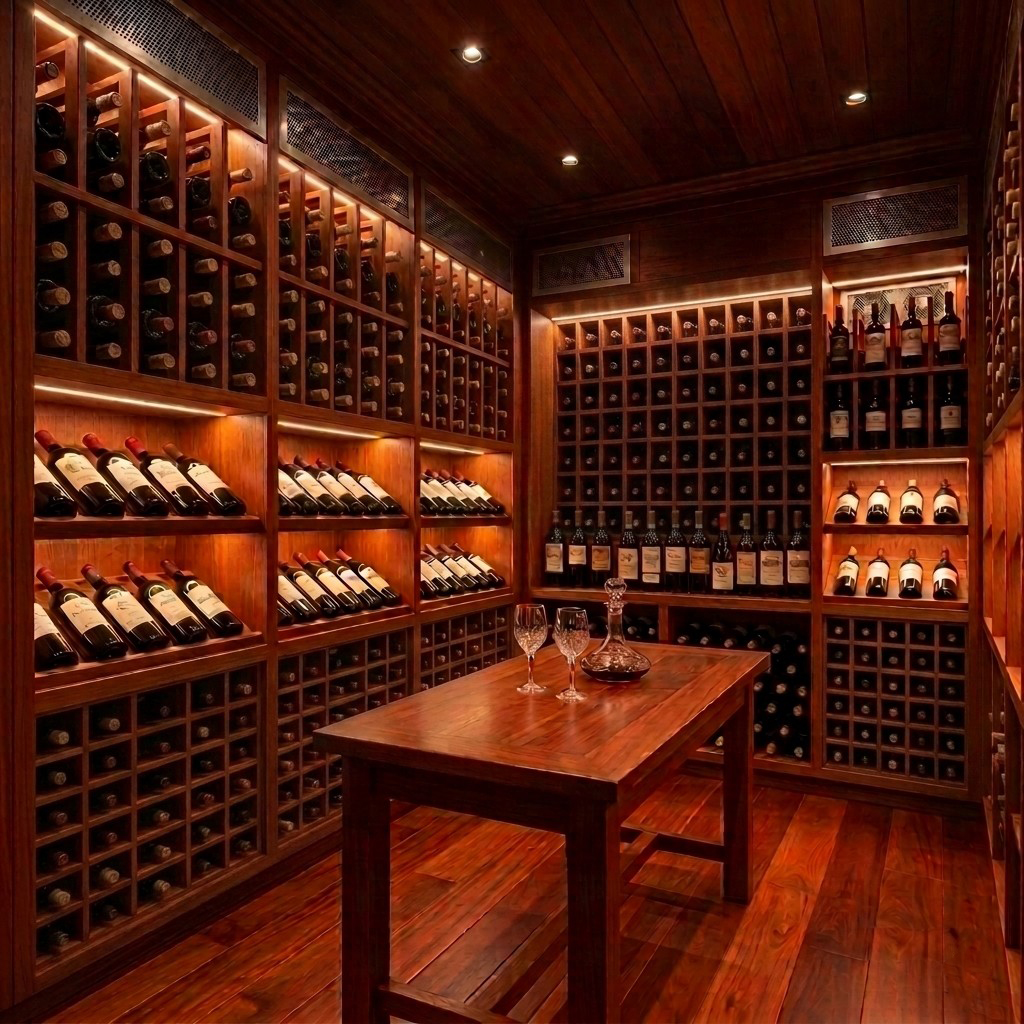
Wine Cellar Cooling in Hot, Humid & Cold Climates: How Your Climate Affects Wine Storage
Wine Cellar Cooling in Hot, Humid & Cold Climates: How Your Climate Affects Wine Storage
A wine cellar may look the same from the outside whether it is in Arizona, Florida, Colorado, California, or New England—but the environment surrounding that cellar can have a major impact on how well it performs.
A wine cellar cooling system does more than lower the temperature. It must maintain a stable environment for your collection despite the conditions outside the cellar. Hot summers, high humidity, freezing winter temperatures, seasonal temperature swings, and even the location of the cellar within your home can all affect how the space should be designed and cooled.
This is why choosing a wine cellar cooling system based only on the size of the room can lead to problems.
The right approach considers the climate, construction, surrounding environment, insulation, humidity, and heat load before selecting equipment.
Whether you are planning a new custom wine cellar or upgrading an existing one, understanding how climate affects wine storage can help you avoid costly mistakes and protect your collection for years to come.
Why Climate Matters for Wine Cellar Cooling
Wine is sensitive to environmental changes. Long-term storage requires a relatively stable temperature and controlled humidity rather than the temperature swings commonly found in living spaces, garages, attics, or other unconditioned areas.
A properly designed wine cellar generally aims for a temperature around 55°F, with stable conditions and appropriate humidity.
But maintaining that environment becomes more difficult when the space is surrounded by extreme temperatures.
Consider two wine cellars that are identical in size:
One is located inside a conditioned basement that stays close to 70°F year-round.
The other is located against an exterior wall in a garage that reaches 100°F in summer.
The rooms may have the same square footage, but their cooling requirements can be dramatically different.
The same principle applies in reverse. A cellar located in a cold climate may have periods when the surrounding environment becomes colder than the desired wine storage temperature.
The climate surrounding the wine cellar is part of the cooling equation.
Wine Cellar Cooling in Hot Climates

Hot climates present one of the biggest challenges for wine cellar design.
When temperatures outside the cellar rise significantly, more heat moves through walls, ceilings, doors, glass, and other surfaces. The cooling system must continuously remove that heat to keep the cellar at its target temperature.
This is particularly important in locations such as:
Arizona
Nevada
Texas
Southern California
Florida
Parts of the Southeast
Other regions with very high summer temperatures
A wine cellar in a hot climate does not necessarily need a larger cooling unit simply because it is hot outside. What matters is the total heat load entering the cellar.
That heat load can be affected by:
Cellar size
Insulation
Vapor barrier
Exterior walls
Ceiling construction
Ambient temperature
Glass doors and windows
Direct sunlight
Door openings
Lighting
The temperature of adjacent rooms
Location of the cooling equipment
Hot Garages Can Be Especially Challenging
Garage wine cellars deserve particular attention.
A garage can become dramatically hotter than the living areas of a home, especially when exposed to direct sunlight or an uninsulated roof.
If a wine cellar is built inside a garage, the cooling system must be selected based on the actual conditions surrounding the cellar, including the highest expected ambient temperature.
A system that performs well during mild spring weather may struggle when the garage reaches its summer peak.
This is one reason a proper heat load calculation is so important.
How to Protect a Wine Cellar in a Hot Climate
The cooling system is only one part of the solution.
A well-designed hot-climate wine cellar should also have:
Proper wall and ceiling insulation
A correctly installed vapor barrier
A well-sealed wine cellar door
Appropriate glass specifications
Minimal air infiltration
Properly designed cooling equipment
Adequate space for the cooling system to reject heat
Think of the cellar like a high-performance cooler.
The better the insulation and seal, the less heat enters the space. That allows the cooling system to maintain the desired temperature without constantly fighting unnecessary heat gain.
For a deeper look at cooling capacity and heat load, see our guide on How to Size a Wine Cellar Cooling Unit.
Wine Cellar Cooling in Humid Climates
Hot temperatures are not the only concern.
Humidity can create another set of challenges for wine cellar owners.

Regions such as Florida, Louisiana, coastal areas, and other humid climates can introduce significant moisture into a wine cellar if the room is not properly constructed.
The goal is not simply to make the room cold. The cellar needs to maintain a stable environment without allowing excessive moisture to move into the walls or create condensation problems.
Why the Vapor Barrier Matters
A wine cellar vapor barrier is an important part of the room's construction.
Without proper moisture control, warm, humid air can migrate toward colder surfaces. When that moisture encounters a sufficiently cold surface, condensation can occur.
Over time, moisture problems can contribute to:
Mold or mildew
Damaged building materials
Moisture accumulation
Poor cellar performance
Excessive workload on the cooling system
This is why wine cellar construction should be considered together with cooling-system design.
A cooling unit cannot compensate for a poorly constructed room.
Humidity and Wine Storage
Humidity also matters inside the cellar.
Extremely dry conditions can contribute to cork-related concerns, while excessive humidity can encourage mold growth and damage labels and surrounding materials.
A properly designed wine cellar cooling system helps maintain an environment appropriate for wine storage, but the construction of the room and the surrounding climate still matter.
In humid climates, homeowners should pay particular attention to:
Vapor-barrier installation
Insulation
Door seals
Condensation
Cooling-unit specifications
Drainage requirements
The temperature and humidity of adjacent spaces
The objective is stable, controlled conditions—not simply the lowest possible temperature.
Hot and Humid Climates Can Create a Double Challenge
The combination of high temperature and high humidity can be particularly demanding.
A cellar in a hot, humid region may have to deal with both:
Significant heat entering the room
Significant moisture in the surrounding air
That makes proper construction especially important.
A poorly insulated or improperly sealed cellar can force the cooling system to work harder while increasing the potential for moisture-related problems.
For homeowners in these climates, it is especially important to consider the entire wine cellar assembly—not just the cooling unit.
Wine Cellar Cooling in Cold Climates

Cold climates create a different set of challenges.
It may seem counterintuitive to worry about cooling a wine cellar when outdoor temperatures are below freezing. But a wine cellar still needs to maintain a stable environment rather than simply follow outdoor temperatures.
During winter, an inadequately designed cellar may become too cold.
Wine should not be exposed to freezing temperatures, and repeated temperature swings are undesirable for long-term storage.
This creates an important distinction:
A wine cellar cooling system is designed to cool. It is not automatically a heating system.
If the surrounding space can become colder than the desired cellar temperature, the overall design needs to account for that condition.
Depending on the location and equipment, this may mean:
Keeping the surrounding space temperature controlled
Providing an appropriate heat source
Selecting equipment specifically designed for the installation
Following the manufacturer's minimum operating-temperature requirements
Avoiding locations where the cooling system or cellar can be exposed to freezing conditions
Cold-climate wine cellar design should therefore consider both summer heat gain and winter temperature conditions.
What About Seasonal Temperature Swings?
Some regions experience dramatic changes between summer and winter.
A cellar may be surrounded by very warm conditions in July and much colder conditions in January.
That means the system should not be evaluated only according to the average annual temperature.
Instead, consider the range of temperatures the cellar will experience throughout the year.
This is especially important for cellars located in:
Garages
Basements with exterior exposure
Outbuildings
Rooms beneath roofs
Exterior additions
Unconditioned areas
A wine cellar should be designed around its real environment—not an assumed average temperature.
Why Wine Cellar Construction Matters as Much as the Cooling Unit
One of the most common mistakes homeowners make is thinking that a powerful cooling unit can overcome a poorly constructed wine cellar.
It cannot.
The cooling system and the room work together.
Proper wine cellar construction should address:
Insulation
Adequate insulation slows heat transfer between the cellar and surrounding spaces.
Vapor Barrier
A properly installed vapor barrier helps control moisture movement through the walls and ceiling.
Door Sealing
A properly sealed door helps prevent warm, humid air from entering the cellar.
Glass
Glass doors and windows can add significant heat load, particularly when exposed to sunlight.
Ceiling and Floor
The spaces above and below the cellar can have a major effect on heat transfer.
Adjacent Rooms
A cellar next to a hot garage or unconditioned space will have different requirements than one surrounded by conditioned living space.
These details should be considered before the cooling system is selected.
Does Climate Determine the Size of a Wine Cellar Cooling Unit?
Climate is an important factor, but it is only one part of the calculation.
The correct cooling capacity depends on the total heat load of the wine cellar.
Important factors include:
Cellar dimensions
Total cubic volume
Insulation
Vapor barrier
Ambient temperature
Climate
Cellar location
Glass
Doors
Lighting
Heat-producing equipment
Desired storage temperature
This is why two wine cellars with the same dimensions can require different cooling systems.
A 500-bottle cellar in a temperature-controlled interior room may have very different requirements from a 500-bottle cellar located in a hot garage.
Bottle capacity does not determine cooling capacity. Heat load does.
For a more detailed explanation, read How to Size a Wine Cellar Cooling Unit: BTU Requirements, Heat Loads & Expert Tips.
Through-the-Wall vs. Split Systems in Different Climates
Climate can also influence which type of cooling system makes the most sense.
Through-the-Wall Cooling Systems
Through-the-wall systems contain the cooling components in one unit and are installed through the cellar wall.
They can be an effective choice for many residential wine cellars.
However, they exhaust heat into an adjacent space.
That means the surrounding room must be capable of handling the additional heat.
In a hot climate, this consideration becomes especially important.
Installing a cooling unit that exhausts heat into an already hot garage, attic, or enclosed space may create an environment that makes it harder for the system to operate efficiently.
Split Cooling Systems
Split systems separate the evaporator and condenser components.
The condenser can be located remotely, allowing heat and mechanical noise to be moved away from the wine cellar.
This can be particularly useful when:
The cellar is large
The surrounding room is already warm
Heat rejection is difficult
Noise is a concern
A remote condenser location is available
The design requires a clean, quiet appearance
The right system depends on the specific installation rather than climate alone.
Can a Standard Air Conditioner Cool a Wine Cellar?
A standard residential air-conditioning system is designed primarily for human comfort.
A wine cellar has a different objective.
The goal is to maintain a stable environment appropriate for long-term wine storage, often at temperatures lower than a typical home's comfort setting and for extended periods throughout the year.
A dedicated wine cellar cooling system is designed specifically for this type of application.
That does not mean every wine cellar requires the same equipment. The appropriate system depends on the room, climate, construction, heat load, and design.
Climate-Specific Wine Cellar Planning
Before selecting cooling equipment, homeowners should ask a few basic questions.
If You Live in a Hot Climate:
What is the highest temperature surrounding the cellar?
Is the cellar located in a garage or other unconditioned space?
Where will the cooling system exhaust heat?
Is the cellar adequately insulated?
Is there direct sunlight on glass or exterior walls?
If You Live in a Humid Climate:
Is the vapor barrier properly designed?
How will condensation be managed?
Is the cellar door properly sealed?
Where will moisture go?
Is the cooling system appropriate for the humidity conditions?
If You Live in a Cold Climate:
How cold can the surrounding space become?
Could the cellar temperature fall below the desired storage temperature?
Does the cooling equipment have minimum ambient-temperature requirements?
Is supplemental heat necessary?
Will the cellar experience significant seasonal temperature swings?
If You Live in a Variable Climate:
Consider the extremes—not just the average.
Your wine cellar needs to perform during the hottest part of summer and the coldest part of winter.
Climate Should Be Part of the Wine Cellar Design From the Beginning
One of the easiest ways to create problems is to design the wine cellar first and figure out cooling afterward.
The better approach is to consider the room, climate, construction, and cooling system as one integrated design.
Before construction begins, determine:
Where the wine cellar will be located
What temperatures surround the space throughout the year
How the walls, ceiling, and floor will be insulated
How the vapor barrier will be installed
Whether the room will include glass
Where the cooling system will be installed
Where heat will be exhausted
Whether the system needs to accommodate unusually hot or cold conditions
The actual heat load of the room
Which cooling system is appropriate for the application
Planning these details before construction can prevent expensive modifications later.
The Right Wine Cellar Cooling System Depends on More Than Your Climate
Whether you live in a hot desert, humid coastal region, cold northern climate, or an area with significant seasonal changes, the fundamental goal remains the same:
Create a stable environment that protects your wine collection over the long term.
Your climate affects how difficult that goal may be—but it does not determine the solution by itself.
A successful wine cellar combines:
Proper insulation
Correct vapor-barrier design
A well-sealed room
Appropriate glass and doors
Proper heat-load calculations
Correctly sized cooling equipment
Appropriate heat rejection
Consideration of seasonal conditions
The most important thing to remember is that wine cellar cooling is not simply about making a room cold.
It is about controlling the environment surrounding your collection.
Final Thoughts: Design the Cellar for Your Climate
The best wine cellar cooling system is not necessarily the largest, most expensive, or most powerful system available.
It is the system properly matched to the room and the environment.
A cellar in a hot garage has different requirements than one in a cool basement. A humid coastal home presents different construction concerns than a dry desert climate. And a cellar in a cold-weather region needs to account for winter conditions as well as summer heat.
That is why climate should be considered before selecting a wine cellar cooling unit.
If you are building a new wine cellar or replacing an existing cooling system, start with the room's construction and environmental conditions, then determine the actual heat load and select equipment accordingly.
For additional guidance, explore our complete guide to wine room cooling units and our wine cellar cooling unit sizing guide.
At Wine Appreciation, we have been helping wine collectors find reliable wine storage solutions since 1973. Whether your collection belongs in a custom wine cellar or a professional wine cabinet, the right environment is the foundation for protecting your investment.